.png)
Does Fasting Balance Hormones After 40 — What the Biology Actually Says

Updated: May 8
The claim appears constantly in wellness content aimed at adults over 40: fasting balances hormones. It resets insulin. It restores growth hormone. It reduces estrogen dominance. It fixes cortisol. Follow the right protocol and your hormonal environment will stabilize.
The biology is more complicated than this — and for many high-performing adults over 40, acting on the simplified version of this claim has produced the opposite of the intended result.
Does fasting balance hormones after 40? The honest answer is: sometimes, partially, and only under specific conditions that most fasting protocols do not account for.
Does Fasting Balance Hormones After 40 — What It Does to Insulin
The strongest case for fasting as a hormonal intervention is its effect on insulin — and this is also where the claim has the most legitimate support.
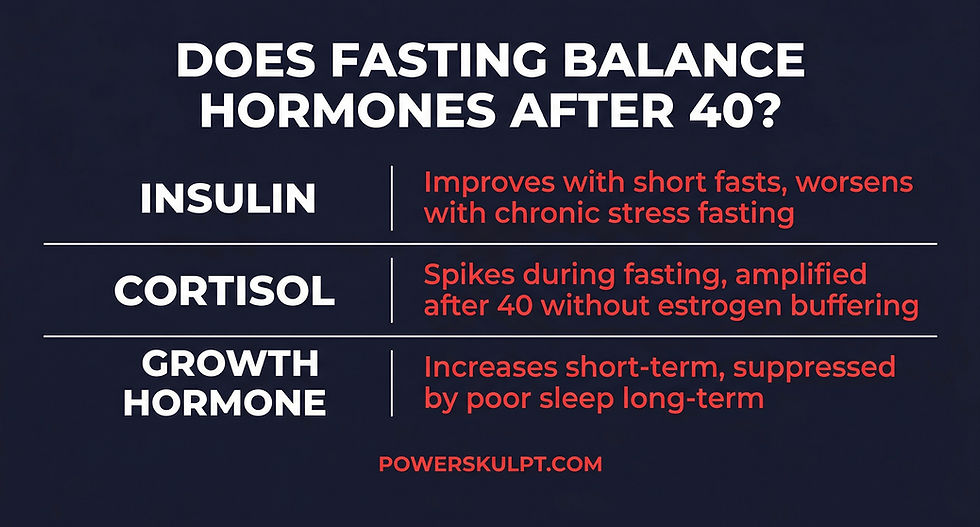
Fasting reduces circulating insulin by removing the dietary stimulus that triggers insulin release. Over time, periods of low insulin allow cells to restore insulin sensitivity — the ability to respond appropriately to insulin signaling rather than requiring progressively higher insulin levels to achieve the same glucose disposal effect.
For adults over 40 who have developed insulin resistance through chronic high-carbohydrate intake, sedentary patterns, and elevated cortisol, intermittent fasting can contribute meaningfully to insulin sensitivity restoration. This is real and supported by research.
The limitation is context. Insulin sensitivity improvement from fasting is diminished — and in some cases reversed — when fasting is performed in the context of chronically elevated cortisol. Cortisol directly promotes insulin resistance. If fasting is triggering cortisol elevation that exceeds the insulin-lowering benefit, the net hormonal effect can be negative rather than positive.
For high-performing adults over 40 carrying significant stress loads, this trade-off is not theoretical. It is one of the primary reasons the 4 biological bottlenecks that stop fat loss after 40 — including insulin resistance — persist despite consistent fasting protocols.
Does Fasting Balance Hormones After 40 — What It Does to Cortisol
This is where the simplified claim breaks down most clearly.
Fasting is a physiological stressor. Like exercise, cold exposure, or caloric restriction, it activates the stress response axis — triggering cortisol release to mobilize energy stores and sustain function in the absence of food. In a body with adequate stress buffering capacity, this cortisol spike is brief, proportionate, and followed by rapid recovery.
After 40, and particularly during and after menopause in women, this stress buffering capacity is reduced. Declining estrogen removes one of the primary modulators of cortisol response. Declining testosterone in men reduces resilience to physiological stress. The adrenal system — already operating under the cumulative load of high-performing adult life — responds to fasting with a larger and more prolonged cortisol elevation than the same protocol would produce in a younger body.
The consequences are direct: elevated cortisol drives visceral fat storage, accelerates muscle protein breakdown, suppresses testosterone and estrogen, disrupts sleep architecture, and worsens insulin resistance. This is the mechanism behind intermittent fasting weight gain after 40 — the protocol designed to reduce fat is triggering the conditions that store more of it. Far from balancing hormones, fasting applied to an already-stressed system can amplify the hormonal dysregulation it is intended to correct.
This does not mean fasting never helps cortisol. Short, well-timed fasting periods in a body with adequate recovery capacity and stable sleep can reduce chronic insulin-driven cortisol elevation over time. The key phrase is adequate recovery capacity — which is precisely the foundation that must be built before fasting becomes a useful hormonal tool rather than an additional stressor.
The recovery-first approach to training smarter after 40 applies equally to fasting: the tool is only as effective as the physiological foundation it operates on.
Does Fasting Balance Hormones After 40 — What It Does to Growth Hormone
Growth hormone is one of the most frequently cited benefits of fasting — and the mechanism is real. Short-term fasting, particularly overnight fasting extended to 16-18 hours, produces measurable increases in growth hormone secretion. Growth hormone drives fat metabolism, tissue repair, and muscle preservation. Its benefits are genuine.
The limitation is what happens to growth hormone over time when fasting is performed in the context of poor sleep — which is one of the most common conditions among high-performing adults over 40.
Growth hormone is secreted primarily during deep sleep. The majority of daily growth hormone output occurs in the first few hours of sleep in the slow-wave stages. When sleep is fragmented, shortened, or architecturally disrupted — as it consistently is in adults over 40 experiencing stress, hormonal transitions, or sleep disorders — growth hormone secretion is significantly reduced regardless of fasting status.
The growth hormone benefit of fasting is therefore contingent on sleep quality. For adults over 40 whose sleep is already compromised, fasting-induced growth hormone increases are partially or fully offset by sleep-related growth hormone suppression. The connection between sleep disruption and fat loss stalling after 40 is directly relevant here — poor sleep does not just reduce recovery, it actively limits the hormonal benefits that fasting is supposed to provide.
Does Fasting Balance Hormones After 40 — What It Does to Estrogen and Testosterone
The evidence on fasting's direct effects on estrogen and testosterone in adults over 40 is considerably weaker than the general wellness narrative suggests.
In premenopausal women, aggressive fasting protocols — particularly those producing significant caloric restriction — can suppress hypothalamic function and reduce estrogen production. This is one of the reasons intermittent fasting and menopause create a particularly difficult hormonal conflict for women over 40. This is the opposite of the hormonal balancing effect the protocols claim to produce. For women in perimenopause whose estrogen is already declining, adding fasting-induced hypothalamic suppression compounds the hormonal depletion rather than correcting it.
For men over 40, the testosterone picture is similarly nuanced. Short-term fasting can produce modest increases in luteinizing hormone — the signal that drives testosterone production. But when fasting is combined with chronic cortisol elevation, inadequate sleep, and insufficient caloric intake to support lean tissue, testosterone declines. Cortisol and testosterone are inversely related. Any fasting protocol that elevates cortisol chronically will suppress testosterone over the same timeframe — regardless of the short-term luteinizing hormone response.
What Actually Balances Hormones After 40
The honest answer to "does fasting balance hormones after 40" is that fasting is one tool in a larger system — and it is not the starting point.
The hormonal environment after 40 is governed by recovery capacity: the body's ability to manage stress load, restore sleep quality, maintain muscle tissue, and regulate the physiological signals that cortisol, insulin, testosterone, estrogen, and growth hormone all depend on.
When recovery capacity is compromised — which it is in the majority of high-performing adults over 40 — introducing fasting as a primary hormonal intervention addresses one variable while worsening several others. The net result is frequently the frustrating pattern of doing everything right on paper and experiencing worsening rather than improving body composition and hormonal markers.
The PowerSkulpt Method addresses hormonal balance through Recovery Engineering, Targeted Biology and Hormone Support, and Strategic Nutrition and Metabolic Clarity — in that sequence, and on that foundation. Fasting, where appropriate, fits within the Strategic Nutrition pillar — applied after recovery is stabilized, cortisol is normalized, and sleep is restored.
The 5 Phases of Rebuilding Metabolism After 40 shows exactly where targeted nutrition strategies — including strategic fasting — fit in the sequence. Phase 1 is recovery stabilization. Everything else follows.
Most programs start with training. PowerSkulpt starts with recovery.
Training creates the signal. Recovery creates the change.
If fasting has not produced the hormonal balance you were expecting after 40, the foundation may need to be addressed first.
Use the free PowerSkulpt Troubleshooter to identify which biological variable is most likely limiting your results — and what needs to be stabilized before any nutritional intervention can work as intended.
For a full assessment of your hormonal environment, cortisol load, sleep quality, and recovery capacity, book a $300 Advanced Consultation with the PowerSkulpt coaching team. We build a protocol around what your biology actually needs — not a generalized fasting schedule designed for someone else.