.png)
How to Build Muscle After 40: Why Most Programs Fail Men and What Actually Works

Updated: Apr 19
If you are a man over 40 who has been training consistently, eating reasonably well, and doing what has always worked — and the muscle is no longer coming — you are not imagining the shift. The body you had in your thirties is not the body you are training today. And the programs built for that younger body are quietly failing you.
This is the question most over-40 men eventually ask: is it harder to build muscle after 40, and if so, how do I actually do it? The short answer is yes, it is measurably harder. But harder is not the same as impossible, and the men who do it successfully are not the men training the hardest. They are the men training the most intelligently.
The Real Reason It Is Harder to Build Muscle After 40
Muscle growth is a conversation between three systems: a training signal, a recovery environment capable of responding to it, and a hormonal milieu that supports protein synthesis. In your twenties and thirties, all three systems operate with significant overhead. You can train recklessly, sleep poorly, eat inconsistently, and still gain muscle — because the biology is forgiving.
After 40, that overhead disappears. Testosterone declines roughly one to two percent per year from the early thirties onward. Growth hormone output during deep sleep decreases. Insulin sensitivity shifts. Recovery capacity — the body's ability to repair from a training stimulus — becomes the rate-limiting factor, not the training itself. At the same time, chronic stress accumulates in ways it did not in your thirties, flattening cortisol rhythms and blunting the anabolic response to training.
This is why how to build muscle after 40 is a fundamentally different question from how to build muscle at 28. The levers have changed. The inputs that mattered most before — volume, intensity, effort — are no longer the primary drivers of growth. Recovery capacity is.
What Changes in a Man's Body After 40
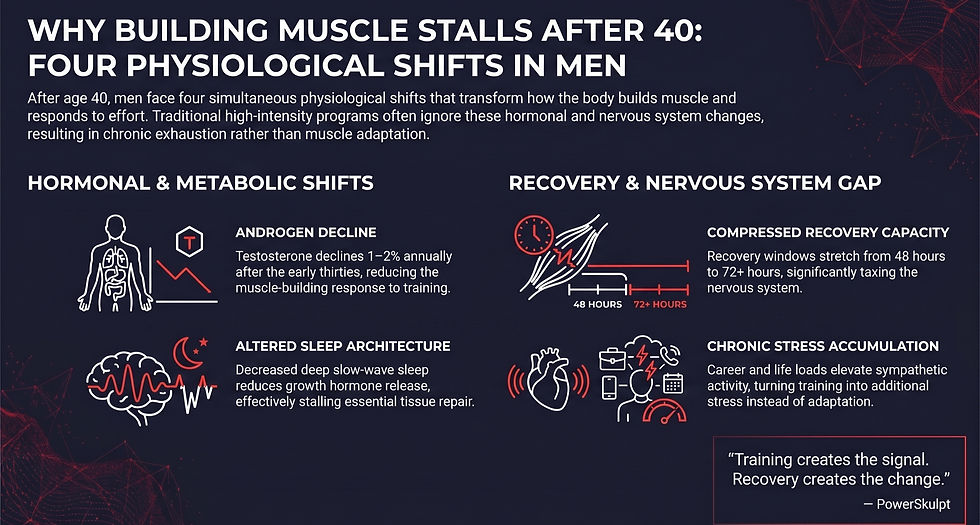
Four physiological shifts do most of the damage to muscle-building potential:
Androgen decline. Testosterone is the primary signaling hormone for muscle protein synthesis in men. As levels drift downward through the forties and fifties, the same training stimulus produces less of a growth response. This is not a call for testosterone replacement — it is a call for training that respects a more conservative hormonal environment.
Compressed recovery capacity. The younger body recovers from a hard training session in 24 to 48 hours. The over-40 body often needs 72 hours or more to fully restore central nervous system function, connective tissue integrity, and glycogen stores. Programs that ignore this produce chronic under-recovery, which presents as stalled progress, persistent soreness, and rising injury risk.
Sleep architecture changes. The percentage of deep, slow-wave sleep — the phase during which growth hormone is released and tissue repair happens — decreases with age. A man getting seven hours of sleep at 45 is not getting the same quality of recovery as a man getting seven hours at 25. This matters more than most programs account for.
Chronic stress accumulation. Career load, financial responsibility, family pressure, and reduced emotional resilience combine to elevate baseline sympathetic nervous system activity. Training is itself a stressor. When added to an already-taxed nervous system, it produces the opposite of adaptation.
These changes are the reason training harder stops working after 40 for most men who try to muscle through with the same intensity that worked in their twenties.
How to Build Muscle After 40: What the Research Actually Shows
The research on hypertrophy in men over 40 is clearer than most programs suggest. Muscle can be built well into the sixties and beyond. What the evidence points to is a specific set of training and recovery conditions:
Lower weekly volume than most programs prescribe. The dose-response curve for hypertrophy is not linear after 40. More sets per muscle group per week beyond a certain threshold produces diminishing returns — and after a tighter threshold, net negative returns. Most over-40 men need less total training volume, not more.
Higher training quality per session. Fewer working sets, taken closer to true muscular failure with strict form, produce better results than many moderate-effort sets. Quality over quantity becomes a biological imperative, not a preference.
Longer inter-session recovery. Two to three properly structured training sessions per week, per muscle group, with genuine rest between them, typically outperforms four or five. The body needs time to supercompensate — and after 40, that time is longer.
Protein intake calibrated to anabolic resistance. Older men experience a measurable decrease in the muscle protein synthesis response to a given dose of protein. Research suggests this is partially offset by slightly higher per-meal protein intake — roughly 0.4 to 0.5 grams per kilogram of body weight per meal — distributed across three to four meals.
Meaningful sleep and stress management. Not as soft peripherals. As part of the training program itself.
This is the architecture of smart training after 40. The men who build muscle after 40 are the ones who accept this architecture. The men who do not — the ones still running programs written for a 28-year-old body — are the ones stalling out.
How to Build Muscle After 40 Without Wrecking Recovery
This is the paradox most over-40 men run into: the harder you train to force muscle growth, the further you push yourself from the conditions that make growth possible. Elevated cortisol, nervous system fatigue, disrupted sleep, and chronic inflammation all blunt the anabolic response to training. You can work harder and get smaller at the same time.
The PowerSkulpt approach inverts the conventional logic. Recovery is not the thing that happens after training so you can train again. Recovery is the foundation that determines whether training produces adaptation at all. When recovery capacity is restored — through targeted nervous system work, sleep optimization, strategic nutrition, and intelligent training volume — the body begins responding to training inputs the way it did a decade ago. Not because the biology has reversed, but because the signal is finally landing in an environment capable of responding to it.
This is the framework most over-40 men have never been given — and it's what the Protocol Briefing walks through in detail.
When Training Harder Stops Being the Answer
There is a specific profile of over-40 man who plateaus in the gym and cannot understand why: disciplined, intelligent, consistent, capable of pushing hard — and going nowhere. Often he is training five or six days a week. Often he has added volume in an attempt to break through. Often he is pushing through fatigue because pushing through fatigue is what worked before.
What he is experiencing is not a motivation problem or a programming problem in the conventional sense. It is a recovery capacity problem. His body is asking for a different conversation. Men who have the same experience as women over 40 — with weight loss frustration after 40 — are often running into the same underlying biology from a different direction.
The answer is not harder. The answer is precise.
Training creates the signal. Recovery creates the change.
Most programs start with training. PowerSkulpt starts with recovery.
The Next Step
If you are an over-40 man who has hit this wall — where the effort is still there but the muscle is not — the Protocol Briefing is the fastest way to see what a recovery-first framework actually looks like. Five minutes. Free. It outlines the architecture most programs skip.
If you want a direct, one-to-one review of where your current approach is breaking down, the PowerSkulpt Advanced Consultation is a 60-minute private session — $300 CAD, includes a 7-day follow-up — where we map your specific situation and define next steps. Email to inquire.