.png)
Retatrutide and Sleep: How Stress and Sleep Are Secretly Killing Your Results After 40
- Rob Lagana
- Mar 4
- 8 min read

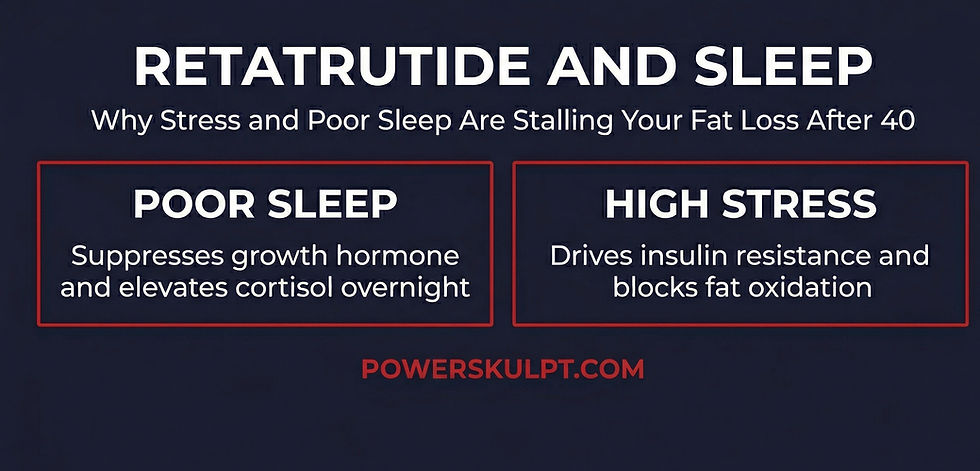
Your dose is right. Your protein is on point. You're training three days a week with walking in between. You've read the diet post, the exercise post, and the dosing guide. Everything checks out on paper.
And the scale hasn't budged in two weeks. Or worse — it's gone up.
Before you touch your dose, before you cut more calories, before you add another training day, ask yourself one question: how are you sleeping?
Because for men and women over 40, the connection between retatrutide and sleep is where most "mystery stalls" actually live.
Why Retatrutide and Sleep Are More Connected Than You Think
Retatrutide creates a caloric deficit through appetite suppression and increased energy expenditure. That deficit is a controlled metabolic stress. Your body is burning stored energy because incoming energy isn't sufficient. That's the entire point.
But your body doesn't experience that stress in isolation. It stacks it on top of every other stressor in your life — work pressure, family obligations, financial stress, poor sleep, and the baseline hormonal shifts that come with being over 40.
Your nervous system doesn't have separate buckets for "diet stress" and "life stress." It has one bucket. And when that bucket overflows, the body's response is the same regardless of the source: cortisol goes up and stays up.
We covered this concept in depth in the nervous system load post, but here's how it applies specifically to Retatrutide:
Chronic cortisol promotes water retention. Not a little — sometimes 3–7 pounds of water that masks weeks of real fat loss on the scale. This is the single most common reason people over 40 think their Retatrutide stopped working when it hasn't. The fat is leaving. The water is hiding it. And the water is there because cortisol is elevated — usually from sleep deprivation or chronic stress.
Chronic cortisol increases insulin resistance. Insulin resistance makes it harder for your body to access stored fat for energy, even in a caloric deficit. This is particularly relevant for women over 40, where perimenopause and declining estrogen are already shifting insulin sensitivity. Add poor sleep and the effect compounds.
Chronic cortisol drives hunger that fights the peptide. Retatrutide suppresses appetite through GLP-1, GIP, and glucagon receptor activity. Cortisol drives appetite through an entirely different pathway — one the peptide can't fully override. This is why people in high-stress periods report that their appetite suppression "stopped working" even though their dose hasn't changed. The peptide is doing the same thing. Cortisol is just louder.
Chronic cortisol preferentially stores visceral fat. Even in a deficit, elevated cortisol can redirect fat storage toward the midsection. You might be losing fat from your arms and legs while your waist stays the same or grows. This isn't genetics — it's a hormonal stress response.
The Sleep Threshold
Here's the number that matters: seven hours. Not seven hours in bed — seven hours of actual sleep.
Below seven hours, insulin sensitivity drops measurably within days. Growth hormone output — which peaks during deep sleep and is responsible for muscle repair, recovery, and fat metabolism — declines significantly. Cortisol's natural overnight reset doesn't complete, so you wake up with elevated levels that carry through the day.
After 40, sleep architecture is already changing. Deep sleep phases shorten naturally. You wake more often during the night. It takes less disruption to drop below the threshold that supports fat loss.
This means the margin for error is smaller. At 30, you could run on six hours for a week and bounce back. At 45, six hours for three consecutive nights can stall fat loss for a week or more — even with a perfect diet and training program.
The 2–4 AM wake-up pattern. If you're falling asleep fine but consistently waking between 2 and 4 AM with difficulty getting back to sleep, that's not random. That's a cortisol pattern. Cortisol naturally begins rising in the early morning hours to prepare you for waking. When baseline cortisol is chronically elevated — from stress, overtraining, or caloric restriction without adequate recovery — that rise happens too early and too steeply. You wake up, your mind starts racing, and sleep quality craters for the rest of the night.
This pattern is extremely common in men and women over 40 using Retatrutide, and it's almost always the result of stacking too many stressors without enough recovery. The deficit from the peptide plus training stress plus life stress plus insufficient sleep creates a feedback loop: poor sleep raises cortisol, which disrupts sleep further, which raises cortisol more.
Stress You Don't Count
The obvious stressors — a hard day at work, a fight with your spouse, financial pressure — are easy to identify. But after 40, the stressors that wreck Retatrutide results are usually the ones you don't think of as stress:
Caloric restriction itself. Being in a sustained deficit is physiological stress. Your body is deliberately resource-deprived. That's the mechanism that drives fat loss, but it's still stress. Every additional stressor on top of it compounds the cortisol load.
Training volume. As we covered in the exercise post, more training isn't more progress after 40. It's more stress. Four intense sessions plus daily walking is the ceiling for most people in a deficit.
Screen time before bed. Blue light exposure after 9 PM suppresses melatonin production, delays sleep onset, and reduces deep sleep quality. This isn't marginal — studies show it can reduce deep sleep by 20–30%.
Caffeine after noon. Caffeine's half-life is 5–6 hours. That afternoon coffee at 2 PM still has half its caffeine active at 8 PM. After 40, caffeine clearance slows further. If you're having sleep issues, caffeine after noon is the first thing to cut.
Alcohol. Even one or two drinks disrupts sleep architecture. You might fall asleep faster, but deep sleep and REM sleep are both significantly reduced. The calorie content is secondary — the sleep destruction is what kills retatrutide results.
Chronic low-grade inflammation. Poor gut health, food sensitivities, or an overly processed diet can maintain systemic inflammation that keeps cortisol elevated. This is subtle, hard to measure, and often overlooked.
None of these feel like "stress" in the way a deadline at work does. But your nervous system counts all of them. And after 40, recovery capacity is lower, which means the threshold before these stressors start compounding is lower too.
The Water Retention Trap
This deserves its own section because it drives more unnecessary dose increases and protocol changes than any other single factor.
Cortisol causes your body to retain water. Not a trivial amount. Men over 40 can hold 3–5 extra pounds of water from sustained cortisol elevation. Women over 40 — especially in the luteal phase of their cycle or during perimenopause — can hold 5–7 pounds.
Here's what that looks like in practice: you're faithfully in a caloric deficit. You're losing half a pound of fat per week. But cortisol-driven water retention is adding a pound. The scale goes up. You think the protocol failed. You increase your dose, add more cardio, cut more calories — all of which raise cortisol further, which causes more water retention.
This is the most common self-defeating cycle we see in clients over 40. The solution is counterintuitive: reduce stress, sleep more, drop training volume slightly, and sometimes eat slightly more for a few days. The cortisol drops, the water releases — often 3–5 pounds seemingly overnight — and the real fat loss that was happening all along becomes visible.
That's the "whoosh effect" people talk about online. It's not magic. It's water retention finally releasing because the stress signal finally dropped.
How to Fix Retatrutide and Sleep Issues Without Medication
You don't need sleep supplements or prescription medication to fix this. You need to treat sleep like the performance variable it is — with the same discipline you give your training and nutrition.
Set a non-negotiable sleep window. Pick a bedtime and wake time that gives you 7.5–8 hours in bed (to get 7+ hours of sleep). Protect it the way you protect your training sessions. This isn't optional on Retatrutide after 40 — it's as important as your dose.
Cut caffeine after noon. No exceptions for two weeks. If your sleep improves, you've found a major contributor. After 40, caffeine sensitivity increases and most people don't realize how much it's costing them.
No screens for 30 minutes before bed. Read a book. Stretch. Sit in silence. The blue light issue is real, but it's also the mental stimulation — your phone keeps your brain in problem-solving mode when it needs to be winding down.
Cool the room. 65–68°F (18–20°C) is optimal. Your body needs to drop its core temperature to initiate deep sleep. A warm room fights that process.
Morning sunlight within 30 minutes of waking. 10–15 minutes of natural light exposure sets your circadian rhythm and improves melatonin production 14–16 hours later. This is free, takes no effort, and is one of the most effective sleep interventions that exists.
Manage the stress bucket actively. If life stress is high, something else has to come down. That might mean dropping from four training sessions to three. Shortening your workouts. Taking a full rest day. Walking instead of lifting. The deficit from Retatrutide is still running — you don't need to add more stress on top of it.
Track it. If you have a wearable that tracks sleep (Whoop, Oura, Apple Watch, Garmin), pay attention to deep sleep and REM percentages — not just total hours. If deep sleep is consistently below 15% of total sleep time, recovery is compromised regardless of how many hours you logged.
The Troubleshooting Sequence
Sleep and stress are step 4 in the troubleshooting order — after dose, nutrition, and training. That's not because they're less important. It's because they're harder to measure and easier to address once the other variables are locked in.
But here's the thing: if dose, nutrition, and training are all dialed and you're still stalled, sleep and stress are almost certainly the bottleneck. There's not a step 5. This is the last piece of the puzzle.
The full diagnostic sequence — which is exactly what the troubleshooter tool walks you through — looks like this:
Step 1: Dose — appropriate for your weight, phase, and timeline? (Dosing guide)
Step 2: Nutrition — are you actually in a deficit with adequate protein? (Diet post)
Step 3: Training — is your volume supporting recovery or fighting it? (Exercise post)
Step 4: Sleep and stress — is cortisol undermining everything else? (This post)
Work through them in order. Fix the first problem you find. Don't try to change everything at once.
And understand that realistic retatrutide results after 40 require all four of these to be working together. The peptide handles the appetite. You handle the environment around it.
The Bottom Line
Retatrutide is a powerful tool. But it operates inside a body that's also processing stress, managing sleep, regulating hormones, and recovering from training. After 40, the margin of error on all of those is narrower.
You can have a perfect dose, a perfect diet, and a perfect training program — and still stall if you're sleeping six hours a night in a high-stress job with caffeine running until 3 PM.
Sleep is not passive recovery. It's active optimization. Stress management isn't soft — it's the variable that determines whether every other variable in your protocol actually works.
Fix the sleep. Manage the stress. Let the cortisol drop. Then watch what happens.
Find out in 60 seconds whether dosing, nutrition, training, or recovery is the bottleneck — and get a personalized action plan.
And if your stall is complex — chronic plateau, multiple compounding factors, bloodwork questions — we offer a $300 Advanced Troubleshooting Consultation with a full protocol audit, nutrition and training review, and 7-day follow-up support.